
Here’s what we’re covering this week:
My thoughts on Bitcoin, Gold, and Oil
Why I added to BRR
This week’s trades
Full portfolio update (all positions)
Portfolio company news
Current watchlist
This week’s Best Buys
Last week I wrote that ProCap Financial was my smallest position at under 1%, and that I’m keeping it small for a reason. This week I took it to 4% which is now pushing the upper limit of how much capital I will add to the position due to its risks.
Nothing about the key-man risk changed this week but there are several catalysts working in Bitcoin’s favor and if Bitcoin outperforms then BRR could be a steal at $2.15. In the bull case the math of where the current share price is doesn’t mak unless bitcoin takes a massive dive and BRR’s AI business is worth nothing. I will walk through the bull and the bear case below.
With the add this week, my cost basis moved from $2.01 to $2.23, which means I paid up from my original basis, and I am currently down 4% on the position.
The rest of the portfolio had a rough week. The S&P 500 finished lower with information technology dropping more than 3% over five days, semiconductors fell nearly 5% as measured by the VanEck Semiconductor ETF, and Walmart’s worst day in more than four years dragged the Dow down 704 points on Thursday. Every company in the portfolio tied to AI infrastructure fell.
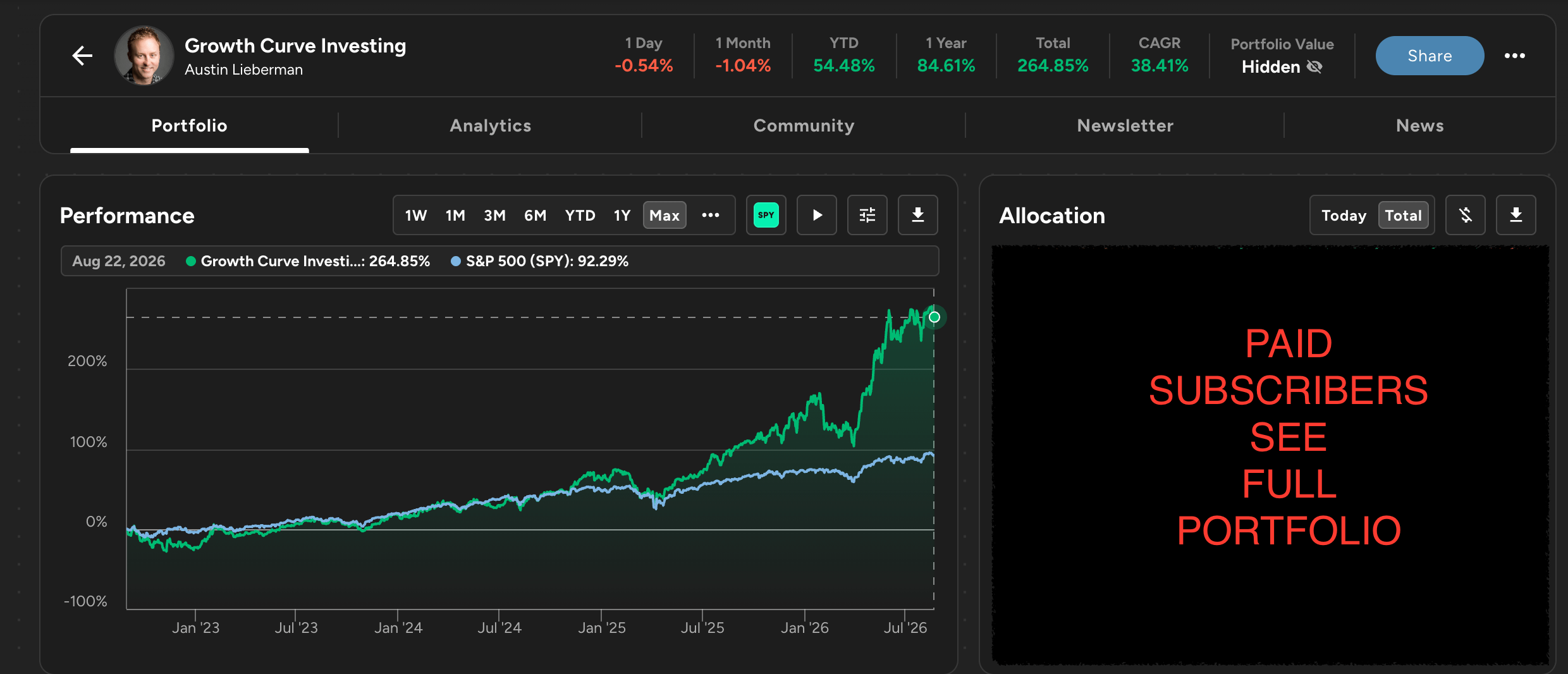
Lifetime performance: the portfolio is up 265% since August 2022, which is a 38% CAGR. It’s up 90% over the past year and 54% year to date.
1. OIL, GOLD AND BITCOIN IN THIS ENVIRONMENT
I usually don’t focus much time on these but the macro backdrop right now is unusual enough that it is worth thinking through, and it feeds directly into why I added to ProCap.
The US-Iran war started at the end of February and is now in its sixth month. The Strait of Hormuz is effectively closed, with Iran holding conditions on reopening it. Brent is around $93 and West Texas is in the mid-$80s, with Brent up more than 20% since August 5 alone. July CPI came in at 3.4% headline and 2.5% core, and PPI ran 4.7% year over year. Treasury yields hit their highest levels in decades this week before pulling back.
And the Federal Reserve has not cut rates all year. The current debate is whether they hike in September, with odds bouncing between roughly 30% and 55%.
On oil and gas. This is the most straightforward of the three. A closed Hormuz removes roughly a fifth of global crude and gas supply from the market, and there is no technological substitute for that on a two-year timeline. Energy producers are generating enormous free cash flow at these prices and most of them are still valued as if crude reverts to $60. The counterargument is that you are buying an asset whose price is set by a war ending, and wars end suddenly. Qatar drafted a proposal in early August, Trump said a deal was possible within days, and Brent fell below $80 for a moment. It then went straight back above $90 when talks stalled. If you own energy here, you are making a geopolitical forecast whether you admit it or not, and I am not good at those. What I would say is that energy is the one sector where the AI power buildout and the war thesis point the same direction, which is more than you can say for most trades.
On gold. Gold has done its job in a strange way. It rose past $5,400 in early March on the war escalation, then had its worst monthly decline since 2008 in March as the market reasoned that oil-driven inflation means a hawkish Fed, and a hawkish Fed is bad for a non-yielding asset. It is around $4,390 now, up about 10% in August but still well below the highs. Central banks bought a quarterly record 288.9 tonnes in the second quarter even as prices fell, which tells you the marginal buyer is not a momentum trader. The case for owning some is that it is the only asset on this list that has actually functioned as an inflation hedge over the full cycle, and the case against is that in a world where the Fed might hike, gold competes with a risk-free rate that keeps going up.
On bitcoin. Bitcoin is now trading around $77,000, down roughly $36,000 from where it traded a year ago, during a period of elevated inflation, war, a closed shipping strait and a Fed that cannot cut. That is the exact scenario the debasement thesis was written for, and bitcoin went down while gold went up.
I think there are two ways to read that, and I do not know which is right.
The first is that the thesis was wrong, or at least incomplete. Bitcoin trades like a high-beta risk asset, not like digital gold, and when real yields go to multi-decade highs it gets crushed alongside everything else with no cash flow. That is a coherent view, and the historical price action supports it.
The second is that the thesis is correct and the timing was wrong, which is what every bitcoin drawdown has looked like from the inside. In that read, an asset that fell 30% while the fundamental case strengthened is the definition of an opportunity, and the reason to look at it now is precisely that everyone stopped talking about it.
I lean toward the second, but I hold that view loosely, and I have sized my exposure accordingly. If I were highly confident, I would own bitcoin directly at a much larger weight instead of a 4% position in a discounted holding company. The ProCap structure is a way to express a moderate view with a margin of safety, because I am buying the asset below its market price and getting an AI business thrown in. If bitcoin does nothing for two years, the discount closing can still make me money. That optionality is why I chose this vehicle over the coin itself or an ETF like IBIT. But admittedly, that could be a safer option than owning BRR.
None of this is a call to sell your growth stocks and buy commodities. I still have 96% of the portfolio in operating businesses. It is a suggestion that if every asset you own is levered to the same variable, which for a lot of us in 2026 is AI capital expenditure, then owning something with a different driver is worth thinking about
2. WHY I ADDED TO BRR
ProCap Financial closed Friday at $2.15. As of August 11, BRR had 88,369,575 shares outstanding, putting market capitalization at around $190 million. The 52-week range is $1.31 to $10.57, so the stock is down about 80% from its high.
The company held 5,355 bitcoin as of June 30, per the 10-Q filed on August 13. Bitcoin is trading around $77,000 after Friday’s rally on the Treasury buyback announcement, making its bitcoin holdings worth about $412 million. Against that sits $99.6 million of remaining 2028 convertible note principal, after management repurchased $135.4 million of those notes for $119.2 million back in February. Cash was $15.3 million at the end of the June quarter.
Take the bitcoin, subtract the converts, add the cash, and you get about $328 million of net assets against a $190 million market capitalization. That works out to $3.71 a share of net asset value and a 42% discount.
One caveat on that figure. The $15.3 million cash number is as of June 30 and the company burns roughly $6 to $7 million a quarter, so the real cash line today is lower. Strip cash out of the calculation entirely and net asset value is $3.54 a share, which is still a 39% discount. The conclusion holds either way.
Everything else in the company is free.
Two more numbers worth having in your head. Bitcoin per share works out to about 6,060 satoshis. And BRR’s average cost basis is roughly $92,100 per coin against a $77,000 market, so management is underwater about 16% on what they bought. That matters because every coin they sell to fund buybacks or operations is sold at a loss, and it reminds you this team hasn't been good at timing bitcoin.
What “everything else” is
Silvia is an AI agent lab focused exclusively on finance, acquired in April 2026. As of the August 10 release, it has more than $50 billion in assets connected across more than 20,000 users. People connect stocks, bonds, crypto, real estate, cars, collectibles, precious metals and private investments, and the agents analyze it. Average user net worth is above $2.5 million. Paying members chat with it more than 20 times a week.
On August 10, the company published a benchmark study on tax. Silvia’s team evaluated seven AI products across ten expert-level tax scenarios covering federal law plus the tax codes of California, Texas, North Carolina, New York and Florida, scored blind on a one to ten scale for factual accuracy. Silvia scored 8.73 and ranked first across every product tested, ahead of Claude Desktop at 8.40.
Then they open-sourced the questions, the results and the evaluation framework so anyone could reproduce it or attack it.
Pompliano’s framing on that release is the actual investment argument: “The largest AI labs on earth employ more researchers than we have employees, and Silvia beat all of them on tax with a team of only four AI engineers working on this problem.”
The piece I think gets overlooked is asset management. In the June quarter the company launched Silvia Innovation Fund I, LP, advised by its wholly owned subsidiary ProCap Investment Advisers. Then on August 13, Tidal Trust IV filed a registration statement for five actively managed ETFs with ProCap Investment Advisers named as the proposed sub-adviser. The 10-Q is explicit that no sub-advisory fees have been earned and no seed capital has been committed, and the funds cannot launch until the registration goes effective.
If that works, it is the whole business. You have $50 billion of connected assets belonging to people worth $2.5 million on average, and you are putting your own funds in front of them. Distribution is the hardest problem in asset management and they may have solved it sideways.
The company also runs ProCap Insights, launched in April as an agentic research product, with data partnerships with Kalshi for prediction market data and Ornn AI.
Revenue in the June quarter was $37 thousand. For the first half it was $38 thousand. Silvia itself contributed $12 thousand of revenue between April 6 and June 30 and lost $8.4 million over that stretch.
The June quarter net loss was $65.0 million, or $0.73 a share, and $49.4 million of that was an unrealized mark on bitcoin. Operating expenses ran $15.0 million, which included a one-time $5.0 million signing bonus for the new chief technology officer. Back that out and the quarterly burn is closer to $6 to $7 million of cash.
Capital allocation
Management has been doing something most bitcoin treasury companies talk about and never do. When the stock trades at a deep discount to net asset value, they sell a small amount of bitcoin and buy back stock, which increases the bitcoin per share owned by everyone who stays.
They did it in March, buying 450 bitcoin while repurchasing 782,408 shares. They did it again on June 1, selling roughly 52 bitcoin to repurchase two million shares at about half of net asset value. Across the first half, they retired 5,238,030 shares for $12.8 million, at an average of $1.85 in the June quarter. There is $84.4 million left on the $100 million authorization.
They also deleveraged into weakness, retiring $135.4 million of converts for $119.2 million and booking a $5.9 million gain.
The company has said it has nearly 20 years of runway at current expense levels. That is only true if you count bitcoin as spendable. Measured in actual cash, they have about two quarters before they have to sell coins to keep the lights on.
The June 2027 problem
This is what potential investors need to fully understand.
The converts mature in December 2028, but holders have the right to require the company to repurchase them for cash at 100% of principal on June 5, 2027. That is why they sit in current liabilities and why working capital is negative $77.3 million. Of the bitcoin, 3,515 coins sit at Anchorage Digital as collateral, of which 3,404 are required under a test that values bitcoin at only 50% for the calculation.
If those notes get put, ProCap either refinances or sells somewhere around 1,300 coins at today’s price to cover $99.6 million. That is a quarter of the stack, and it is the single biggest swing factor in the next twelve months.
THE BULL AND BEAR CASE FOR BRR
The bull case: a closed-end fund that owns an AI startup. You are buying roughly a dollar of net assets for about fifty-eight cents, and the asset is bitcoin, which is still down about $36,000 from where it traded a year ago. So the discount is stacked on top of a drawdown. If bitcoin simply returns to where it was twelve months ago, around $112,500, the stack is worth $602 million and net asset value goes to $5.86 a share. Narrow the discount to the 20% range that treasury companies trade at in better sentiment and you have a $4.70 stock without Silvia contributing a dollar of enterprise value. Close the discount entirely and you are at $5.86. To get above $6 you need Silvia to carry real value or the market to pay a premium, which is exactly what happens if the ETF suite gathers assets. A product with $50 billion connected, 20,000 users and a demonstrated ability to beat frontier labs in a narrow domain has genuine option value at a $190 million market capitalization. Meanwhile, management keeps shrinking the share count at a discount.
The base case: the discount narrows and bitcoin drifts. The most likely outcome is the boring one. Bitcoin trades in a range around current levels, the treasury company discount narrows but does not close because the market has decided the category deserves a permanent haircut, and Silvia grows users without generating meaningful revenue for a couple of years. Buybacks slowly grind bitcoin per share higher. At a flat $77,000 coin and a discount that goes from 42% to 25%, you get to about $2.80, and continued repurchases push that toward $3.00 to $3.50 over eighteen months. That is a fine return for doing nothing, and it is what I am actually underwriting.
The bear case: falling knife. Revenue is essentially zero, and the cost structure is not. Every dollar of expense comes out of a balance sheet that is one volatile asset, and cash is down to $15.3 million from $45.0 million at year end. If bitcoin goes to $50,000, net asset value drops to $2.08 a share and the stock is worth about $1.15 at the current discount. At $40,000 bitcoin, net asset value is $1.47 and you are looking at eighty cents. In that world the converts become a real problem rather than a financing detail, the buyback stops because there is nothing left to do it with, and the company is a forced seller of coins into weakness. There is also a resale registration covering 20,100,833 shares held by selling securityholders that has been effective since January, which is a standing overhang rather than new news, though the August 19 prospectus supplement put it back in front of people. And the concentration risk is not only in bitcoin. Pompliano is the vision, the distribution, the investor communication and the media presence. The chief investment officer resigned in April. If something happens to him, or he simply loses interest, there is very little institutional depth behind him.
How I sized it
4% is a position where a total loss costs the portfolio four points and does not change my life. A five-bagger adds twenty points.
I want to be clear that this is the highest-risk company in the portfolio by a wide margin. It is not a Rule Breaker in the David Gardner sense. It is closer to a special situation with a lottery ticket stapled to it, and it is the only position in the portfolio I would describe that way.
3. THIS WEEK’S TRADES
Added to ProCap Financial (BRR). Took the position from roughly 1% to 4% of the portfolio. Average cost is now $2.23, up from $2.01. This is the only trade I made.
4. FULL PORTFOLIO
Thirteen positions, no cash, prices as of Friday’s close.