
PORTFOLIO UPDATE +220%
4 Buys. NBIS Earnings Preview. GameStop Update. NU Deep Dive Preview
Happy Tuesday,
The big near-term event for the portfolio is NBIS earnings tomorrow before the open, so we’re going to focus on previewing the report.
The portfolio closed Monday up 220% lifetime against the S&P 500’s 82% over the same time period, with a 37% CAGR and 108% trailing twelve months. The trailing one-month return is 30%, which is the second straight month of 25%+ returns. That is not a normal cadence and I’ll get into how I’m thinking about it in the portfolio section.

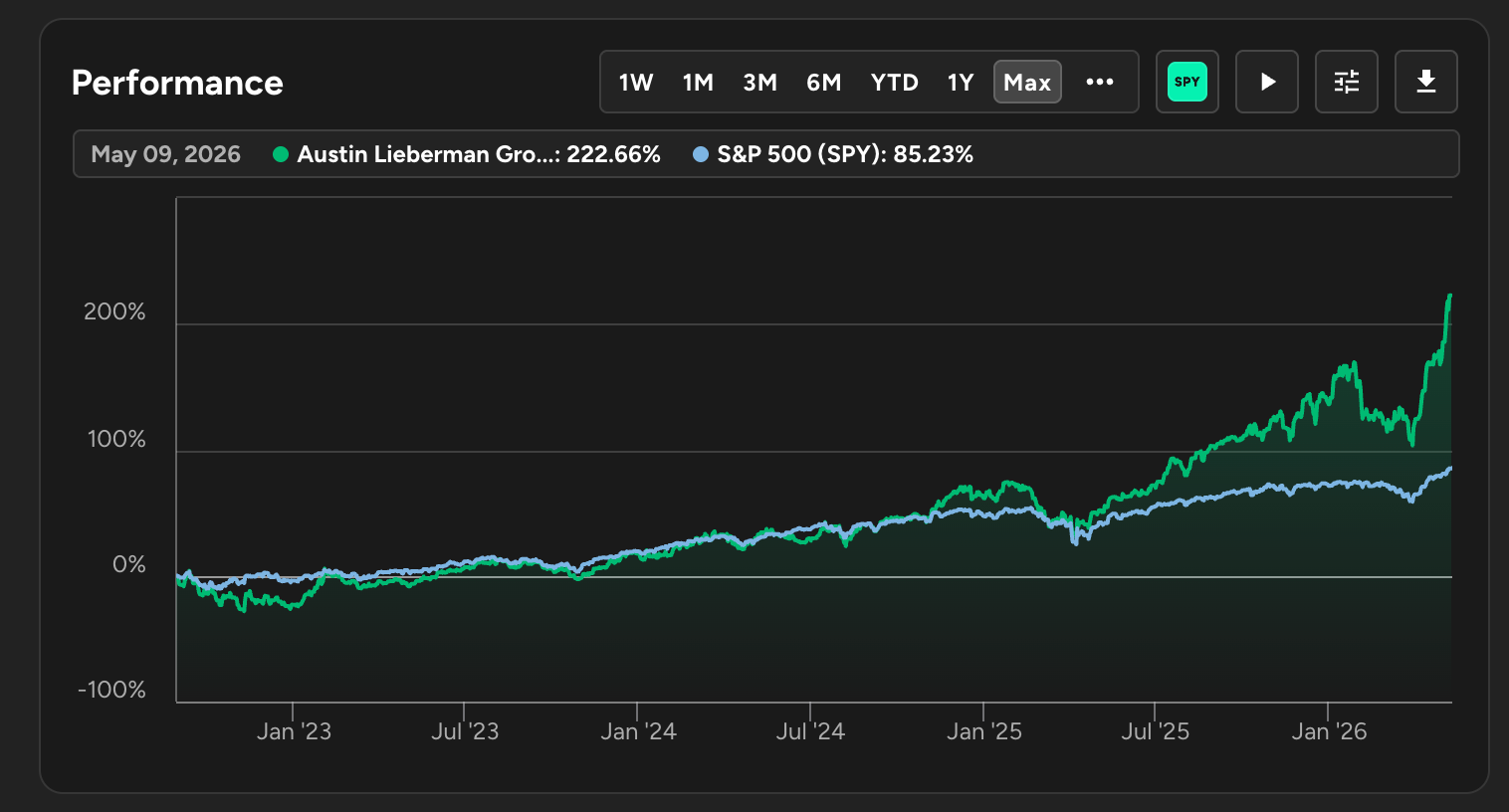
The cash from my GME sale has been fully redeployed into 4 purchases. I’ll cover all four later in this email.
First we’re going to cover a NBIS earnings preview, an update on the Everpure rebrand (formerly Pure Storage), a reflection on Gamestop since I sold my shares last week, and a teaser for next week’s full deep dive on Nu Holdings (NU), which is a promising company that I’ve been wanting to spend more time on.
Earnings Preview: Nebius (NBIS)
Reports: Wednesday, May 13, before market open Conference call: 8:00 a.m. ET Closed Monday at: $186.10 Position size in portfolio: 13.48% Total return on position: +111.75%
NBIS is the position I have spent the most time thinking about over the past two weeks. The stock has doubled from my cost basis. The thesis has gotten stronger, not weaker. And the company is heading into a print where expectations are high but the contracted revenue gives it more downside protection than the typical AI infrastructure name at this multiple.
What Wall Street Expects
Revenue around $316.9 million, up roughly 6x year over year
Loss of $0.81 per share, in line with the prior 30 days of estimate revisions
The Street is watching for sequential growth off Q4’s $227.7M revenue print
The headline numbers matter less than the operating commentary, which is where the call is going to be won or lost.
What I’m Actually Watching
1. ARR trajectory toward the $7B to $9B 2026 target. Management exited 2025 at $1.2B in core AI cloud ARR. Getting from $1.2B to a midpoint of $8B in twelve months requires roughly 7x growth in committed annualized run-rate. The Meta and Microsoft contracts make that possible. The near-term stock performance will likely be tied to whether the company tracks ahead of or behind that revenue run-rate.
2. Deployment status on Meta and Microsoft. The Meta deal is up to $27B over multiple years. The Microsoft deal is $19.4B. Plus a $2B equity investment from Nvidia. Combined, the contracted backlog is roughly $50B against a company with $228M in quarterly revenue. The market wants to see those contracts converting into recognized revenue and an updated capacity build-out timeline.
3. The Eigen AI integration timeline. Nebius acquired Eigen AI for $643M on May 1. Eigen is an inference and model optimization specialist. The thesis is that Nebius can use Eigen technology to extend Token Factory, the higher-margin Platform-as-a-Service layer, into the much more profitable inference layer of the AI stack. Any commentary on integration timing and revenue contribution will be heavily scrutinized.
4. CapEx and EBIT path. The company has guided to $16-20B in capex for 2026, with management expecting EBIT to remain negative for the full year. About 60% of that capex is already funded between cash, commitments, and expected operating cash flow. Watch for any update on financing the remaining ~40%. The market has gotten more comfortable with capex from hyperscalers, but Nebius is small enough that funding mechanics still matter.
The Bear Case I’m Watching
Two things give me pause heading into the print.
The first is insider selling. Directors and executives have sold approximately $14.7 million in shares over the past three months. That doesn’t change my thesis (the stock has more than doubled, partial insider trims are normal), but it’s a data point worth flagging. The market will scrutinize the magnitude of that selling more closely if the company’s tone shifts on the call.
The second is competitive positioning. CoreWeave is the most direct comparable in the public market. Both companies are positioning themselves as the “non-hyperscaler” AI infrastructure provider. If Nebius commentary on differentiation gets thin, or if pricing pressure shows up in gross margin trends, the multiple compresses fast.
Setup and Stance
My base case is that Nebius beats the revenue line, reiterates or modestly raises the $7-9B ARR target for 2026, and provides enough operational color on Meta and Microsoft deployments to maintain the narrative. The stock has run a lot, so even a clean print may not produce a big move higher. The risk skews toward a sharp drawdown if any one of the three things (ARR pace, hyperscaler deployment milestones, or capacity timeline) disappoints.
I’m holding through earnings. The position is up 111.75% and I have full conviction in the underlying thesis. I’d rather take the risk of a post-earnings drawdown than try to time a re-entry on a name where the contracted backlog gives me unusual visibility for the multiple I’m paying.
Everpure (formerly Pure Storage)
Quick note for subscribers who saw “P” appear in the portfolio screenshot below and wondered what happened to PSTG.
Pure Storage rebranded to Everpure in February and started trading under the new name on March 5. The ticker stayed PSTG initially but has now changed to “P.” The reasoning behind the rebrand is that Pure has been pushing for years to evolve from a flash storage hardware vendor into an enterprise data management platform. The Everpure name captures that evolution, alongside the recently completed acquisition of 1touch (a data discovery and classification specialist) that closed Monday, May 11.
I have mixed feelings about the rebrand on the surface. There’s already a well-known company called Everpure that makes water filters, owned by Pentair. The name overlap will create some confusion in the trademark space. But the strategic substance is what matters, and the substance is clearly right. Pure was always going to be commodity-pressured if it stayed locked into selling flash arrays. Adding metadata, classification, and AI-readiness on top of the underlying storage gives them a software margin profile they did not have before.
The stock has finally started getting Wall Street attention. Everpure (P) closed Monday at $87.34, up roughly 29% in the past week alone. The position is back in the green for me after being underwater. My thesis hasn’t changed since I first bought PSTG. What changed is that the market has decided this is a credible AI data management play and not just a storage vendor. I’m holding.
A GameStop Update
I sold my GME position on April 21st and used the proceeds to fund the buys in the cash deployment section below. At the time, I told subscribers I couldn’t see a logical plan for Ryan Cohen and that I’d rather have my capital in companies whose strategy I could actually model.
In the weeks since, that decision has aged in ways I genuinely did not predict.
On May 4, GameStop made an unsolicited $56 billion bid to acquire eBay. GameStop’s market cap going into the announcement was roughly $11.9 billion. The company is offering to pay roughly four times its own market cap in a half-cash, half-stock transaction. The cash side has GameStop’s ~$9B balance sheet plus a $20B financing letter from TD Bank, which still leaves a funding gap of billions of dollars before you get to the $28B cash component. The stock side requires GameStop to issue a large number of new shares.
The last couple of weeks have been a slow-motion case study in why I sold. Cohen sat for a CNBC interview the day of the announcement and got combative when asked basic questions about the math. His response, more or less, was “the details are on our website.” He has had no conversations with eBay’s management. Last Tuesday on TBPN, he was more expansive about his turnaround plan, focused on aggressive cost cuts and faster deleveraging. Over the weekend, he posted a chart on X showing eBay’s declining buyers, GMV, and operating income alongside rising costs, captioned “only in corporate America” with a poop emoji.
Michael Burry sold his entire GameStop stake on May 5, writing that the deal’s leverage shattered the “Instant Berkshire” thesis he had been building. His public note read in part: “Any which way I sliced it, the Instant Berkshire thesis was never compatible with greater than 5x Debt/EBITDA, never ok with interest coverage under 4.0x.” He pointed out that the proposed transaction would put the combined company at roughly 7.7x net debt to EBITDA.
The piece of reporting that crystallized things for me came out last week. Cohen’s January compensation package is tied to a $100 billion market cap target. So there’s a personal incentive structure pushing him toward exactly this kind of swing-for-the-fences acquisition. That’s not a knock on Cohen as an operator. He genuinely built Chewy from nothing. But it’s a clear answer to the question of why a $12 billion company would try to buy a $46 billion company without a realistic financing plan in place.
If I HAD to bet, I would bet that the eBay deal does not happen. I see no reason any eBay investor or employee would want Cohen to become CEO. GME has trailed both eBay and the S&P 500 during Cohen’s tenure as CEO.
Anthony Pompliano is supposedly interviewing Cohen today, and I suggested he ask him that question. We’ll see how the interview goes.


eBay shares are trading around $108 against a $125 offer, which tells you the market is skeptical but not dismissive. The bottom line is that I’m not interested in owning a speculative/meme stock where the management team’s compensation structure points toward financial engineering rather than operating results.
The takeaway I’d offer to subscribers is the same one I had last week. There’s no shame in saying a position is outside your circle of competence. There’s a lot of shame in losing money on a thesis you never actually understood. I sold GME at a small loss. The capital is now compounding in companies whose growth drivers I can write down on a piece of paper, against management teams whose decisions are based on executing at their current company, not speculating about running other companies. That’s a trade I’d make every time, regardless of what GME does next.
Next Week’s Deep Dive: Nu Holdings (NU)
I’ve been working on a deep dive into Nu Holdings for a few weeks, and I’m planning to publish it to paid subscribers next week. The setup is one of the cleanest I’ve seen this year, and the timing lines up with the company reporting Q1 earnings this Thursday morning (May 14), which means subscribers will get my full thesis and post-earnings reaction in one shot.
Here’s the short version of why I’m interested.
Nu Holdings is the Brazilian digital bank that has grown from a credit card startup in 2014 into the largest private financial institution in Brazil by customer count, with 131 million customers across Brazil, Mexico, and Colombia. The company ended 2025 with $16.3 billion in revenue (up 45% YoY on a currency-neutral basis), $2.9 billion in net income, a 33% return on equity, and an 86% monthly activity rate. Those are not normal numbers for a bank. They are not normal numbers for any business.
The piece I keep coming back to is the runway. Nu serves 60% of the adult population in Brazil, which sounds like saturation until you look at the average revenue per active customer. ARPAC in Brazil is roughly $15 per month. ARPAC in Mexico, where Nu has only penetrated 14% of the population, is already $12.50 per month, and Mexico’s GDP per capita is 40% higher than Brazil’s. The Mexico opportunity alone could be larger than the entire current Brazil business. Then layer Colombia. Then layer the international expansion the company has signaled for the back half of 2026.
The company also announced last month that it plans to invest $8.2 billion in Brazil in 2026, nearly double the rate of two years ago. Critically, that investment is being funded out of reinvested profits and operating cash flow, not capital raises. That’s a company throwing off real cash from its existing business and choosing to double down on its core market rather than pull back.
I’d put the NU thesis alongside MELI in the bucket of “Latin American fintech businesses Wall Street is structurally underrating because of currency and macro noise.” MELI is the e-commerce flywheel. NU is the banking flywheel. Both are compounding at rates the US fintech market hasn’t seen in 20 years, yet the multiples don’t reflect it.
The full deep dive next week will cover the bull/base/bear framework, the international expansion path, the regulatory and competitive risks, my entry price target, and exactly how I’d size the position. If you’re not already a paid subscriber and you want it in your inbox, this is the week to upgrade.
The rest of this email, including the four positions I added to this week, the full portfolio walkthrough, and my thinking on SNDK now that it’s grown to 23% of the book, is for paid subscribers.